PWM DC Motor Controller
Industrial-grade PWM DC motor controllers from Ameronics deliver precise, efficient DC motor speed control for 12 V to 90 V brushed and permanent-magnet DC motors in automation, mobile equipment, packaging machinery, and battery-powered systems.
What is a PWM DC Motor Controller
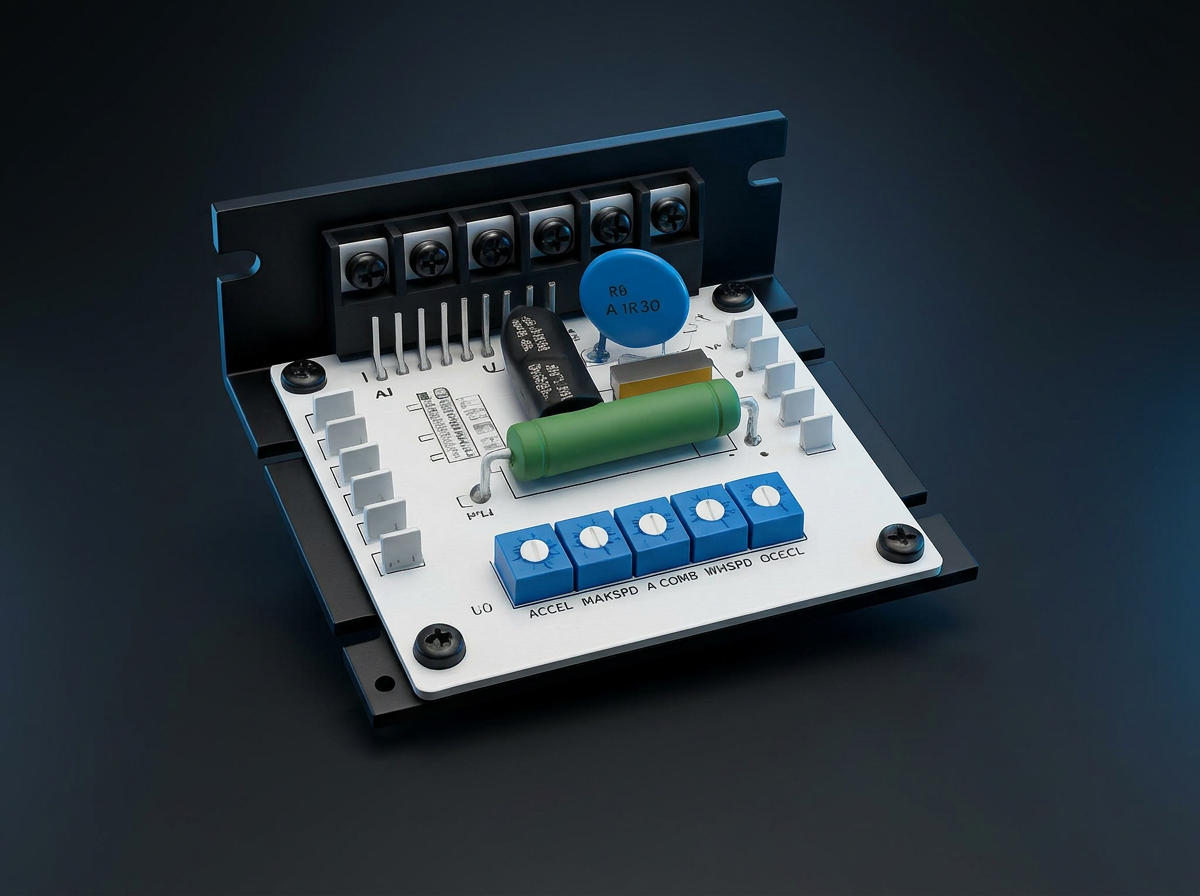
A PWM DC motor controller is a power-electronic device that regulates the speed and torque of a DC motor by switching the supply voltage on and off at high frequency. The acronym PWM stands for pulse-width modulation — instead of dropping voltage across a resistive element (which wastes energy as heat), the controller delivers full-voltage pulses of varying width to the motor, and the motor's own inductance averages those pulses into a smooth equivalent DC voltage.
For OEMs and integrators, this means a compact, efficient, and thermally well-behaved drive that gives precise DC motor speed control from a few percent of rated speed up to full speed, with a clean torque profile throughout. PWM is the dominant approach to low-voltage motor control for permanent-magnet and brushed DC motors in the 12–90 V range — covering everything from 12 V mobile platforms to 72 V and 90 V automation buses, and it now anchors most modern DC motor drive controllers built for low-voltage industrial duty.
Duty cycle in one paragraph: a PWM controller switches the DC bus on and off at a fixed high frequency (commonly 10–30 kHz). The fraction of each cycle the switch stays on is called the duty cycle. A 25 % duty cycle on a 48 V bus delivers an average of 12 V to the motor, 50 % delivers 24 V, and 75 % delivers 36 V — and because a brushed or permanent-magnet DC motor's no-load speed is approximately proportional to its average armature voltage, varying the duty cycle directly varies the motor's speed. The motor's own inductance smooths the pulse train into a near-continuous current, so the motor responds as if powered by a clean adjustable DC source.
For higher-power industrial DC motors fed directly from AC mains, the right tool is a phase-controlled SCR DC motor drive; Ameronics manufactures both non-regenerative and four-quadrant SCR drives for 90/180 V motors. For applications that require braking energy recovery — hoists, downhill conveyors, centrifuges, web tensioners — a regenerative DC drive should be specified instead. Because Ameronics builds all three topologies in-house — see the full DC motor drive controller lineup for a side-by-side overview — you can match the drive to the application without compromise.
How PWM Motor Control Works
At the heart of every PWM DC motor controller is a power switching stage — typically MOSFETs for low-voltage designs and IGBTs for higher-power variants. A control circuit produces a high-frequency carrier (commonly 10–30 kHz, well above the audible band) and modulates its pulse width based on the speed reference and the feedback signal.
The duty cycle — the ratio of on-time to total period — determines the average voltage delivered to the motor. A 25% duty cycle on a 48 V bus delivers an average of 12 V, 50% delivers 24 V, and so on. Because the switching elements operate either fully saturated or fully off, conduction losses are minimized and the controller runs cool even at high current.
Understanding PWM duty cycle
The duty cycle is the ratio of the switch's on-time to the total switching period, expressed as a percentage. At 0 % the motor sees no voltage; at 100 % the motor sees the full DC bus. Everything in between is a linear blend of those two states. On a 48 V bus, for example, a 25 % duty cycle delivers an average of 12 V, a 50 % duty cycle delivers 24 V, and a 75 % duty cycle delivers 36 V — giving the controller stepless, electronically precise DC motor speed control from creep speed to full speed without contactors, gear changes, or resistive dropping.
How PWM voltage controls motor speed
In a brushed or permanent-magnet DC motor, the no-load speed is proportional to the armature voltage (n ≈ Va / ke), while torque is proportional to armature current (T ≈ kt · Ia). By varying the average armature voltage with a duty-cycle command, the PWM DC motor controller directly varies the back-EMF the motor generates and therefore its operating speed. The motor's own armature inductance acts as an integrator, smoothing the PWM pulse train into a near-continuous current with very low ripple — so the motor electrically and mechanically behaves as if it were powered by a clean adjustable DC source.
Efficiency advantages versus linear control
The efficiency case for PWM is decisive. A linear (resistive or series-pass) controller develops the speed-set voltage by dropping the unused voltage across a transistor or rheostat — power that is dissipated as heat. At half speed on a 48 V motor, a linear controller wastes roughly half the input power as heat in the controller itself, requiring oversized heatsinking, fans, or even liquid cooling.
A PWM DC motor controller, by contrast, never operates its switches in the linear region. The MOSFETs or IGBTs are either fully saturated (very low on-resistance, very low loss) or fully off (no current flow). Total conversion efficiency typically stays in the 90–97 % range across most of the speed band, regardless of where the duty cycle is set. For battery-powered equipment that translates directly into longer runtime; for enclosed industrial machinery it translates into lower internal temperatures, smaller cooling, and longer component life.
Closed-loop speed regulation
In closed-loop mode, the controller compares the speed reference against an armature-voltage or tachometer feedback signal and adjusts the duty cycle in real time to hold the commanded speed under varying load. This delivers the tight speed regulation OEM machinery requires — typically within a few percent across the full load range — and is one of the reasons PWM has become the default industrial motor controller topology for low-voltage DC drives.
Current limit and protection
An adjustable current limit clamps the output during starts, overloads, and stalls, protecting both the motor and the switching stage. Combined with thermal protection, soft-start ramps, and reverse-polarity guards, a properly engineered PWM controller turns a brushed DC motor into a robust, field-serviceable industrial actuator.
Get application-engineered pricing on a PWM DC motor controller
Send us your motor voltage, current, duty, and feedback requirements — we'll match a FlexVolt or Pulseguard model and reply within one business day.
Key Features and Benefits
A well-designed PWM DC motor controller offers measurable advantages over linear control, contactor switching, or oversized SCR drives applied at low voltages:
- High efficiency — typically 90 %+ across the speed range
- Smooth low-speed torque without cogging or stalling
- Compact size for panel-mount or in-machine integration
- Battery-friendly current draw extends runtime
- Adjustable current limit, soft start, and soft stop
- Isolated 0–10 V, potentiometer, or 4–20 mA reference inputs
- Optional reversing (H-bridge) operation
- Thermal and over-current protection as standard
Applications of PWM DC Motor Controllers
Because they handle the 12–90 V DC range so efficiently, PWM DC motor controllers are the default choice across a wide span of industrial and mobile equipment. Typical Ameronics deployments include:
Conveyor systems
Variable-speed control for sortation, accumulation, and transfer conveyors driven by 24/48 V brushed or PMDC motors — smooth ramping protects belts, rollers, and product.
Packaging machines
Precise low-voltage motor control for film unwinds, indexers, cappers, and fillers where torque and speed accuracy directly affect throughput and reject rate.
Battery-powered equipment
AGVs, mobile robots, electric utility vehicles, and off-grid pumps benefit from PWM efficiency, which directly extends battery runtime and reduces thermal management overhead.
Automation systems
Material handling, web tensioning, dosing pumps, and OEM machine builds standardized on 24/48/72 V DC buses — PWM gives the integrator a compact, repeatable building block.
For a complete view of how Ameronics DC motor drive controllers fit each segment, see our application notes and case studies.
Why Choose Ameronics PWM Controllers
Ameronics has been designing and manufacturing industrial motor controllers in the United States for decades. Our FlexVolt and Pulseguard PWM DC motor controllers are engineered, assembled, and tested in-house — not re-badged from generic offshore boards.
- •U.S.-engineered and built. Every PWM controller is designed, manufactured, and burn-in tested at Ameronics — full traceability from PCB through final QC.
- •Industrial-duty design. Conformal-coated boards, oversized switching devices, and rugged terminations stand up to vibration, dust, and the thermal cycling typical of OEM machinery.
- •Application-engineered support. Our team helps you size the controller to your motor, select feedback strategy, and integrate the drive into your control system — not just ship a box.
- •Long-term availability. Ameronics supports field-deployed drives for the long haul, with stable BOMs and aftermarket spares — critical for capital equipment and OEM programs.
- •Custom variants on request. Need a specific voltage, current rating, enclosure, or control interface? Our engineering team can adapt the baseline design for your program.
Frequently Asked Questions
What is a PWM DC motor controller?
A PWM (pulse-width modulation) DC motor controller is a power-electronic device that switches the DC supply on and off at high frequency — typically 10 to 30 kHz — to vary the average voltage delivered to a DC motor. By adjusting the duty cycle of those pulses, the controller smoothly varies motor speed and torque while the switching transistors (MOSFETs or IGBTs) stay either fully on or fully off, keeping conversion losses extremely low.
How does PWM control motor speed?
Motor speed in a brushed or permanent-magnet DC motor is approximately proportional to the average armature voltage. A PWM DC motor controller chops the fixed DC bus into a stream of high-frequency pulses; a 50% duty cycle delivers roughly half the bus voltage, and so on. The motor's inductance smooths the pulses into a near-continuous current, so the motor sees a clean equivalent DC voltage with very little ripple.
What is the difference between PWM and SCR drives?
A PWM DC motor controller switches a DC supply at high frequency using MOSFETs or IGBTs and is ideal for low-voltage (12–90 V) DC motors powered from batteries, rectified low-voltage supplies, or DC buses. An SCR DC motor drive uses phase-controlled thyristors to rectify AC mains directly into a controlled DC armature voltage, making it the right choice for 90 V or 180 V industrial DC motors fed from 115/230 VAC. PWM gives smoother current and higher efficiency at low voltages; SCR is rugged, simple, and cost-effective at industrial AC-fed power levels.
What voltage and current range do Ameronics PWM controllers cover?
Ameronics FlexVolt and Pulseguard PWM DC motor controllers cover 12 V to 90 V DC across a range of current ratings suitable for battery-powered equipment, mobile platforms, AGVs, packaging machinery, and 12/24/48/72/90 V industrial automation systems. Custom voltage and current variants are available on request.
Can a PWM DC motor controller reverse direction and limit current?
Yes. Ameronics PWM controllers offer optional reversing (H-bridge) operation, adjustable current limit, soft-start and soft-stop ramps, and isolated 0–10 V, potentiometer, or 4–20 mA reference inputs — all standard requirements for OEM and integrator applications.
Are PWM controllers efficient?
Yes — PWM is the most efficient way to control a brushed or permanent-magnet DC motor at low voltage. Because the switching MOSFETs or IGBTs operate either fully on (very low on-resistance) or fully off (no current flow), conduction and switching losses are small, and a well-designed PWM DC motor controller typically achieves 90–97 % conversion efficiency across most of its speed range. By comparison, a linear (resistive or series-pass) controller dissipates the unused voltage as heat in a power transistor or rheostat, so efficiency drops linearly with speed — running a 24 V motor at half speed through a linear controller wastes roughly 50 % of the input power as heat in the controller itself.
What is PWM motor speed control?
PWM motor speed control is the technique of regulating a DC motor's speed by varying the duty cycle of a high-frequency on/off signal applied to the motor's supply. Because the average voltage delivered to the armature is directly proportional to the duty cycle, increasing the duty cycle increases motor speed and decreasing it slows the motor — all with very low losses, since the switching transistors are never operated in their linear (lossy) region. PWM motor speed control is the standard method used in modern industrial motor controllers for brushed and permanent-magnet DC motors from 12 V to 90 V.
Is PWM better than SCR DC drives?
It depends on the motor and supply. For low-voltage DC motors (12–90 V) powered from batteries, rectified low-voltage supplies, or a DC bus, a PWM DC motor controller is the better choice — it delivers higher efficiency, smoother current, and a more compact footprint. For 90 V or 180 V industrial DC motors fed directly from 115/230 VAC mains, an SCR DC motor drive is the better choice because phase-controlled thyristors rectify the AC line directly, with no intermediate DC bus required. Neither technology is universally 'better' — Ameronics manufactures both PWM (FlexVolt, Pulseguard) and SCR (RedVolt, Voltix, Regencore, Revoxa) so the application can be matched to the right topology.
Related drive families
-
DC motor drive controllers (overview)
All Ameronics DC motor drive families — SCR and PWM — in one place.
-
SCR DC Motor Drive
Phase-controlled DC drives for 90/180 V industrial motors fed from 115/230 VAC.
-
Regenerative DC Drive
Four-quadrant drives that recover braking energy back to the AC line.
-
FlexVolt & Pulseguard products
Full PWM controller specifications, models, and ordering details.
Speak with an engineer about your PWM DC motor controller
Whether you need a stock FlexVolt or Pulseguard model or a custom-engineered variant, our U.S.-based application engineers will help you select the right controller, define the control interface, and integrate it into your machine. We respond within one business day.